Members are invited to Join and Create Groups in the City of Shamballa to Merge Heaven and Earth and Unite Humanity as One.
Mars Colonization Timeline

Last update was made on 30th July, 2017.
The timeline will get a major update when SpaceX will reveal its updated plan for Mars later this year.
2010s – The Mars hype is there
2016 – Elon Musk reveals SpaceX plans for the Interplanetary Transport System (ITS, formerly known as Mars Colonial Transporter).
2016 – ESA&Roscosmos's ExoMars Trace Gas Orbiter enters Mars orbit, but Schiaparelli lander crashes on the surface of Mars.
2018 – NASA's InSight lander lands on Mars at Elysium Planitia.
2020s – Preparing for human arrival

2021 – SpaceX's Red Dragon becomes the first private spacecraft to land on Mars, and the largest overall. Onboard is an experimental plant to produce oxygen from Martian atmosphere. It is followed by 2nd Red Dragon in the same year.
2021 – The location for SpaceX's future "Mars Base Alpha" is selected.
2021 – ESA&Roscosmos's ExoMars rover lands on Mars.
2021 – NASA's Mars 2020 rover lands on Mars together with a small demonstration helicopter.
2021 – First Chinese orbiter, lander and rover reaches Mars.
2021 – United Arab Emirates Hope probe enters Mars orbit.
2023 – 3rd Red Dragon lands near the selected location of future Mars Base Alpha with a drill and an experimental propellant plant to produce oxygen and methane from Martian atmosphere and soil.
2023 – NASA's next generation (solar electric ion thrusters, broadband laser communications) Next Mars Orbiter enters Mars orbit.
2023 – India's Mangalyaan 2 orbiter and lander reaches Mars.
2024 – A communications satellite is placed at Sun-Earth Lagrangian point L5 to overcome the problem of periodic communications blackout with spacecrafts temporary behind the Sun.
2024 – SpaceX's ITS prototype booster and spaceship make first unmanned orbital test flight.
2025 – A group of unmanned Red Dragons land near the location of future Mars Base Alpha with deployable solar panels, experimental greenhouse and autonomous In Situ Resource Utilization (ISRU) system containing a chemical plant to produce water and nitrogen and an improved propellant plant (capable to produce and store liquid methane and oxygen); Dragons are automatically interconnected to make a single system.
2025 – Another Red Dragon lands on Mars to retrieve samples collected by Mars 2020 rover and launch them back to Earth.
2025 – Japan's Martian Moons Explorer lands on Phobos to collect samples and return them to Earth in 2029.
2027 – The first unmanned demonstration ITS spaceship "Heart of Gold" lands on Mars near the location of future Mars Base Alpha; basic post-landing procedures are tested, the propellant plant onboard the ship refills it with propellant and ship launches back to Earth.
2029 – Several unmanned ITS spaceships land at Mars Base Alpha: a backup crew ship (which can serve as a temporary habitat), a cargo ship with ISRU system, small nuclear power reactor and a few cargo ships with rovers, miner/tunneling droids, solar panels and parts for a modular habitat and other equipment.
2029 – Some of modules for NASA's Mars Base Camp (a manned station orbiting Mars) are prepositioned in Mars orbit.
2030s – First human bases on Mars

2031 – 12 SpaceX astronauts aboard an ITS spaceship land at Mars Base Alpha becoming the first humans on Mars. The first modular habitat is built.
2031 – NASA's Deep Space Transport with 4 astronauts reaches Mars orbit and docks with the prepositioned modules to complete the Mars Base Camp; first human missions to Phobos and Deimos.
2033 – NASA's Deep Space Transport leaves Mars Base Camp to come back to Earth.
2033 – Half of SpaceX's 1st crew leaves Mars but the other half stays to maintain Mars Base Alpha and become the first permanent human colonists on Mars.
2033 – 2nd SpaceX's crew of ~30 astronauts and workers aboard an ITSspaceship lands at Mars Base Alpha. A hydroponic greenhouse is built to provide Mars Base Alpha with locally grown vegan food. "The Mars Society" establishes its first chapter on Mars :)
2033 – First unmanned landers land at the chosen location of NASA's Mars Surface Field Station a few thousand miles from Mars Base Alpha.
2033 – Blue Origin's unmanned landers for its Blue Mars base land on Mars several hundred miles from Mars Base Alpha.
2035 – First full-crew ITS spaceship with 100 human colonists and workers lands at Mars Base Alpha.
2036 – NASA's Deep Space Transport reaches Mars Base Camp. 4 NASA's astronauts land at Mars Surface Field Station.
2036 – 1st Blue Origin's astronaut crew lands at Blue Mars base.
2036 – The ISRU capabilities of Mars Base Alpha are extended not only to produce air, water and rocket fuel, but also steel, bricks, cement and basic fertilizers, plastics and silica products (as glass). Some industrial size 3D printers are also assembled, as well as equipment to make Martian soil usable in the greenhouse. First reality show on Mars is transmitted to Earth and called "Mars One" :)
2037 – First child is born on Mars at Mars Base Alpha. His voyage to Earth later in his life would be dangerous because of his bones and organs not being fit for Earth's gravity.
2037 – NASA's 1st crew leaves Mars.
2037 – Blue Origin's 1st crew leaves Mars.
2037 – Second full-crew ITS spaceship with 100 human colonists and workers lands at Mars Base Alpha, which now has a population of more than 200. Among them is SpaceX's founder Elon Musk.
2038 – More powerful modular nuclear power reactor is installed at Mars Base Alpha.2037 – First child is born on Mars at Mars Base Alpha. His voyage to Earth later in his life would be dangerous because of his bones and organs not being fit for Earth's gravity.
2037 – NASA's 1st crew leaves Mars.
2037 – Blue Origin's 1st crew leaves Mars.
2037 – Second full-crew ITS spaceship with 100 human colonists and workers lands at Mars Base Alpha, which now has a population of more than 200. Among them is SpaceX's founder Elon Musk.
2038 – 2nd Blue Origin's crew consisting of permanent colonists lands at Blue Mars base.
2038 – Cyanobacteria is introduced into the ISRU processes for Mars Base Alpha.
2038 – A fish farm is built at Mars Base Alpha to provide more diverse local food for the colonists. The greenhouse is vastly expanded.
2039 – Work begins to build a new underground section of Mars Base Alpha with larger habitats and working areas to boost the population capacity of Mars Base Alpha to 1000.
2040s – When bases grow into colonies

2040 – NASA's 2nd generation Deep Space Transport with nuclear powered VASIMR engine reaches Mars Base Camp in record-breaking time. 8 astronauts land at Mars Surface Field Station.
2040 – Two more ITS spaceships with 200 human colonists, workers and some wealthy tourists land at Mars Base Alpha.
2040 – 3rd Blue Origin's crew lands at Blue Mars base, which now has a population of ~50.
2041 – NASA's 2nd crew leaves Mars.2041 – The new underground section of Mars Base Alpha is finished. Now the colonists have a lot spacier living and working quarters and the first domed plaza on Mars.
2041 – Cultured meat "farm" is built at Mars Base Alpha, adding meat (although artificial) to the diet of the colonists.
2042 – Virgin Galactic establishes the first luxury hotel at the outskirts of Mars Base Alpha.
2042 – Two more ITS spaceships with 200 passengers land at Mars Base Alpha, which now has a population of more than 500.
2042 – Blue Origin is starting to construct its Mars Orbital Station (a spining station with artificial gravity of 0.38g) to receive/send spaceships from/to Earth and shuttle passengers up and down to Mars surface.
2043 – Several small proxy bases for scientific, mining and other purposes are established within a few tens of miles from Mars Base Alpha.
2043 – A regular transport route between Mars Base Alpha and Blue Mars base is established.
2044 – International team of 12 astronauts and scientists lands at Mars Surface Field Station. It is now reorganized into a permanent international scientific research base with scientist crews rotating every Earth-Mars synod (26 months).
2044 – Two more ITS spaceships with 200 passengers land at Mars Base Alpha.
2044 – A constellation of satellites with global positioning system (GPS) and global communications system is placed in high orbit around Mars. Now it's hard to get lost on Mars; possibly only in a severe sandstorm.
2044 – Blue Origin's Mars Orbital Station is constructed and the first shuttle lands at Blue Mars base.
2045 – Large deposit of minerals with high concentration of rare metals is discovered a few hundred miles from Mars Base Alpha. A research Mining Base Beta is established.
2045 – A land trip all around the Mars is completed for the 1st time.
2046 – Three more ITS spaceships with 300 passengers land at Mars Base Alpha bringing a nuclear fusion reactor as well.
2046 – Several more Blue Origin's shuttles land at Blue Mars base, boosting its population to more than 200.
2047 – The landing field a few miles from Mars Base Alpha where ITS crew and cargo spaceships has landed and taken off for two decades now is transformed into a small spaceport with pressurized hatchways for both passengers and cargo.
2047 – A regular transport route between Mars Base Alpha and Mining Base Beta is established.
2048 – Four ITS spaceships with 400 passengers land at Mars Base Alpha and one more with 100 (mostly miners) at the Mining Base Beta. The population of the Mars Base Alpha now surpasses 1000 with 200 more colonists living at nearby proxy bases.
2048 – In a joint effort NASA, ESA, India, Japan, SpaceX and several asteroid mining companies are starting to build the Free Spaceport of Phobos which will serve as a logistics center, way station and fuel depot for manned and unmanned spaceships heading for Mars, Main asteroid belt and beyond.
2048 – 100 more colonists arrive at Blue Mars base.
2049 – A nuclear fusion power station is operational at Mars Base Alpha.
2049 – A new underground section of Mars Base Alpha is finished, boosting its population capacity to 3000.
2050s – From first factory to first domed city
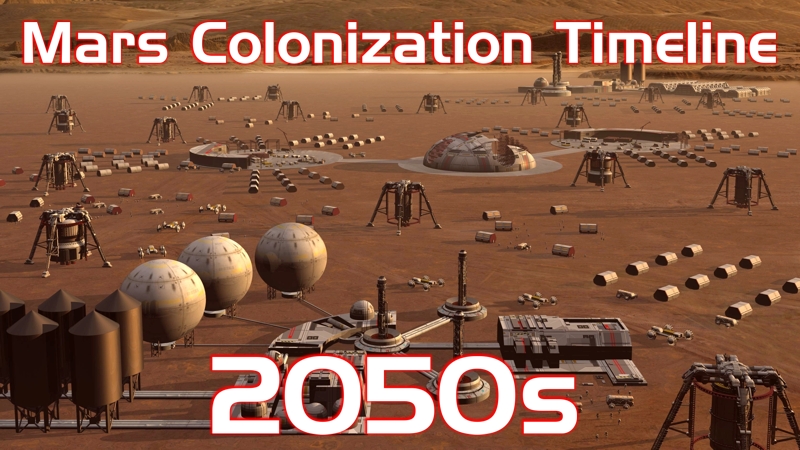
2050 – The ISRU and industrial capabilities of Mars Base Alpha are greatly extended, using the resources harvested in nearby proxy bases. The rover repair depot is upgraded to a factory.
2050 – Earth and Mars is the closest ever since the beginning of the colonization. The largest colonial fleet ever arrives at Mars with 1000 colonists landing at Mars Base Alpha and 200 more at Mining Base Beta. Blue Origin's spaceship fleet with 300 passengers arrives at Mars Orbital Station; the passengers are shuttled down to Blue Mars base, bringing its population to more than 500.
2050 – With China and Russia focusing on the Moon, India is the first Asian superpower to establish its own base on Mars.
2051 – Rail line from Mars Base Alpha to its spaceport is finished.
2052 – The Free Spaceport of Phobos is being finished. Robotic asteroid mining in Main asteroid belt now is rapidly expanding.
2052 – NASA's human mission to Ceres (flying with a new generation nuclear fusion spaceship) stops at Free Spaceport of Phobosto resupply, drop some scientists at Mars Surface Field Station and take additional crew members from Mars.
2052 – There is a long-term staff of 50 now at NASA's Mars Surface Field Station with 50 more scientists rotating every one or two Earth-Mars synods.
2052 – 1500 more colonists land at Mars Base Alpha and Mining Base Beta and 400 more at Blue Mars base. There are now more than 4000 humans permanently or temporarily living on the surface of Mars.
2053 – Around halfway between Mars Base Alpha and Mining Base Beta work begins to build the first domed city on Mars, covering the entire small impact crater a mile across.
2053 – A deuterium separation facility becomes operational at Mars Base Alpha.
2054 – Rail tracks are laid down from the construction site of Dome City to Mars Base Alpha and to industrial complex at Mining Base Beta.
2055 – As more colonists land at Mars Base Alpha it reaches its population capacity of 3000; temporary habitats are built at the outskirts of Mars Base Alpha, at its proxy bases and Mining Base Beta.
2055 – The population of Blue Mars base surpasses 1000, but Indian Mars colony now has more than 200.
2055 – Using its strong presence on the Moon in its favor, China establishes its first colony on Mars which now is being expanded very fast.
2056 – Dome City's transparent but radiation-filtering dome is finished and pressurized, covering an area of almost one square mile; its nuclear fusion power station is finished too; workers move in now to construct the buildings and gardens (with such features as artificial waterfalls) below the dome.
2057 – The new generation of SpaceX's nuclear fusion powered spaceships arrive at the Free Spaceport of Phobos; passengers are shuttled down to the spaceports of Mars Base Alpha and Mining Base Beta. The ITS spaceships are retired from SpaceX fleet after 33 years of successful service and sold to Brazil.
2057 – United Arab Emirates establishes its first base on Mars – the New Dubai.
2058 – Dome City is finished and has a maximum population capacity of 20'000. More than 3000 move in in the first year mostly from overpopulated Mars Base Alpha and its outskirts.
2058 – Dome City's spaceport is finished.
2059 – SpaceX's nuclear spaceships bring more colonists to Dome City.
2059 – First Brazilian ITS spaceship lands at Mars Base Alpha.
2060s – Nuclear fusion spaceships open up Mars

■ Dome City's population reaches the level you can't anymore made the decisions by corporate hierarchy or direct democracy only. First city council on Mars is elected.
■ The expanded Free Spaceport of Phobos more and more serves as a space logistics hub not only for colonies on Mars but for mining activities in Main asteroid belt as well. Korea, United Kingdom, Canada and Australia begins participating in the spaceport project.
■ First humans born on Mars travel to Earth using exoskeletons as body-support because of Earths heavier gravity.
■ United Kingdom, Canada and Australia establish their research base on Mars.
■ Commercial companies from various nations open their branches and operations on Mars.
■ Tourism from Earth is expanding on Mars. Although the trip is still expensive and only the rich can afford it. Besides its high-tech cities and bases Mars can offer spectacular safari rides and if you are really wealthy you can hire some of the guides to take you to the caldera of Olympus Mons, depths of Valles Marineris or other exclusive locations.
■ More and more Brazilian colonists make Mars Base Alpha their new home.
■ Blue Mars is expanded into a second domed city on Mars. A high-speed railway line is built between Dome City and Blue Mars.
■ First measures to start the terraforming process of Mars are made, powdering Martian polar ice caps with black lichen to reduce their albedo and melt the ice and building automatic halocarbon factories throughout Mars to produce and release super-greenhouse gases in Martian atmosphere.
■ Artificial magnetic field generator is placed at Sun-Mars Lagrangian point L1 to shield Mars from solar radiation with the generated magnetotail and help the terraformation process of the planet.
■ The Free Spaceport of Phobos is a starting point for NASA's human mission to Galilean moons of Jupiter.
■ Nuclear fusion powered spaceships (greatly reducing the travel time from Earth and widening the launch window) bring more colonists to Mars than ever before. In 2060s the human population on Mars expands from ~10'000 to more than 50'000 with Dome City alone having 20'000.
2070s – Human outposts spreading past Mars

■ The Free Spaceport of Phobos is the main supply node for human outposts on Ceres, Vesta, Pallas, asteroids in Main asteroid belt and Galilean moons of Jupiter.
■ Cyanobacteria and methanogens are spread in lower regions of Mars to further increase the terraformation process.
■ Mars Base Alpha is finally sold to Brazil. Though very few of the original colonists still live there.
■ The old workhorse of human colonization of Mars - the ITS spaceships - are finally retired completely. The oldest of them are 50 years old now.
■ Dome City is expanded with two more domes of similar size and several smaller ones.
■ There are now 5 domed cities on Mars. All of them are interlinked with high-speed railway lines.
■ The cluster of Indian colonies on Mars is starting to specialize on growing food for human space outposts in Main asteroid belt and beyond, as Mars is the closest object to them with substantial gravity, which is needed for growing crops.
■ The Free Spaceport of Phobos is a starting point for NASA's human mission to the moons of Saturn (Titan, Enceladus and other).
■ Now almost all of space-faring nations are represented on Mars with a base, a city block or a corporate enterprise.
■ In 2070s the human population on Mars expands from 50'000 to 200'000 with the largest colony - Dome City - having 50'000. Four more cities have a population of more than 15'000.
2080s – Mars gets its self-government
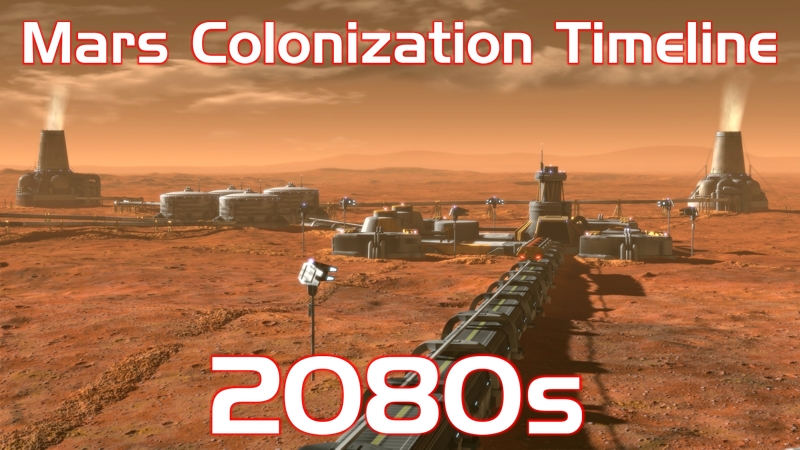
■ First Martian Council, consisting of proportionally drawn representatives from every Martian city and base, is assembled on the principle of self-government. The Council deals with the issues important for all of the Martians (as ongoing terraformation initiatives or building a space elevator) and acts as a representative for Martian population in relations with the corporations and governments of Earth.
■ As space elevators on Earth and on Moon become operational, the cost of launching any mass to Mars and elsewhere into space is slashed considerably, greatly speeding up the use of space resources and space colonization.
■ Tourism from Earth is becoming more and more mainstream. Now even a middle-class people can afford a trip to Mars if they save for that.
■ Despite criticism China builds the first prison on Mars. Soon other colonies are quietly sending there their criminals too.
■ More powerful halocarbon factories are set up throughout Mars. The bacterial and lichen coverage around Mars is further increased.
■ Connected base stations for downward and outward space elevators on Phobos are built; work begins to build both space elevators. The downward elevator will cut short of the upper edge of Mars's atmosphere with a shuttle platform at its tip. The outward elevator will have several platforms at different points to catch and release payloads (including spaceships) to Earth/Lunar orbit, to Main asteroid belt and to Galilean moons of Jupiter.
■ Work begins to build a large shuttle port at the summit of the Martian volcano practically on the equator - Pavonis Mons - for shuttles heading to and coming from Phobos space elevator.
■ In 2080s the human population on Mars expands from 200'000 to 500'000 with the largest of the Martian cities - Dome City - surging past 100'000 inhabitants. Particularly large colonial fleet arrives on 2082 when Earth and Mars is the closest since 2003, only 55.9 million kilometers (34.7 million miles) apart.
2090s – The millionth Martian

■ The Phobos space elevator system is finished, greatly speeding up the colonization of Mars, interplanetary trade and the growth of human outposts in Main asteroid belt and Galilean moons of Jupiter.
■ The shuttle port at the summit of Pavonis Mons quickly expands into one of the largest human colonies on Mars - Pavonis City, which is soon connected with other major Martian cities by high-speed railway lines.
■ Establishment of Pavonis City greatly speeds up tourism in some of the most spectacular Martian regions nearby - Tharsis Montes, Olympus Mons, Noctis Labyrinthus and Valles Marineris. Tourist bases and hotels are popping up there fast. One of the high-speed railway lines runs through all the length of Valles Marineris.
■ Almost all colonists have left Mars Base Alpha with its obsolete infrastructure; it is declared now a national heritage site, preserving the 1st human colony on Mars as it was in the middle of 21st century.
■ As air pressure and temperature is slowly increasing in the result of terraformation activities, new human colonies are being set up mainly in the lower regions, particularly Hellas Planitia and Valles Marineris, where the results of terraformation can be felt first.
■ In 2090s the human population on Mars reaches 1 million. Finally Elon Musk's goal to put 1 million people on Mars is reached.
■ The shuttle port at the summit of Pavonis Mons quickly expands into one of the largest human colonies on Mars - Pavonis City, which is soon connected with other major Martian cities by high-speed railway lines.
■ Establishment of Pavonis City greatly speeds up tourism in some of the most spectacular Martian regions nearby - Tharsis Montes, Olympus Mons, Noctis Labyrinthus and Valles Marineris. Tourist bases and hotels are popping up there fast. One of the high-speed railway lines runs through all the length of Valles Marineris.
■ Almost all colonists have left Mars Base Alpha with its obsolete infrastructure; it is declared now a national heritage site, preserving the 1st human colony on Mars as it was in the middle of 21st century.
■ As air pressure and temperature is slowly increasing in the result of terraformation activities, new human colonies are being set up mainly in the lower regions, particularly Hellas Planitia and Valles Marineris, where the results of terraformation can be felt first.
■ In 2090s the human population on Mars reaches 1 million. Finally Elon Musk's goal to put 1 million people on Mars is reached.
22nd century – Mars becomes independent

■ Mars becomes practically self-sufficient, having to import only the most complex goods and intellectual property.
■ The self-sufficiency results in Mars becoming an independent nation-state. The Martian government has to buy up the non-Martian governmental assets located on Mars.
■ As a technologically advanced frontier society Mars and orbital stations around it become the primary source of specialists and workers needed for human bases and missions further in Main asteroid belt and outer Solar system.
■ Air pressure and temperature on Mars is increased to the level where there is flowing water on the surface and simple plants can be introduced into newly created biosphere of the planet.
■ As one of the lower regions on Mars close to the equator Valles Marineris is seeing the most benefits from terraformation activities and Phobos space elevator; cities and farming communities are spreading throughout the valleys and at the end of the 22nd century there are nearly 5 million people living in Valles Marineris. It's the most populous urban area on Mars.
■ In the 22nd century the total human population on Mars increases 30-fold - to more than 30 million.
You need to be a member of The City of Shamballa Social Network to add comments!

Replies